

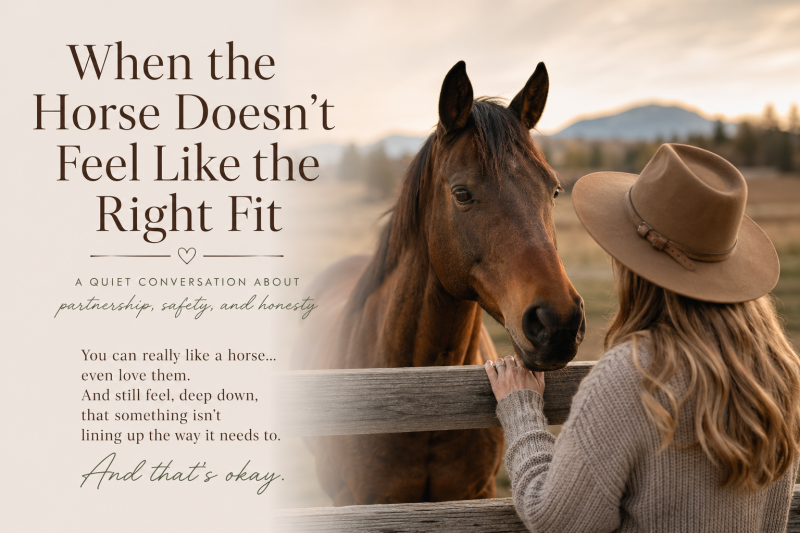
a quiet conversation about partnership, safety, and honesty
There’s a moment that doesn’t get talked about very often. Not in the happy photos, not in the “look how far we’ve come” stories, and not even much at the barn. It’s quieter than that. It’s the moment when you start to feel like something… isn’t quite right. And I’ll be honest with you—this is something I’ve experienced more than once.
Maybe nothing big has happened. No dramatic incident, no clear reason you can point to. Just a feeling that the horse you hoped would feel like home… doesn’t. And that can bring up a lot. You start asking yourself questions like, am I doing something wrong? Should I be able to handle this? Do I just need more time? I’ve asked myself those same questions, and like so many others, I responded by trying a little harder. Showing up, pushing through, telling myself it would get better if I just stayed consistent enough.
I think a lot of women sit in that place longer than they need to, quietly carrying it because even questioning the partnership can feel like failure. But what I’ve come to understand, both through my own experiences and working with others, is that not every horse is meant for every person. And that isn’t about ability or effort—it’s simply the reality of partnership.
And there’s another layer to this that matters just as much… you can really like a horse and it still not be the right fit for you. You can enjoy them, appreciate them, even love them, and still feel deep down that something isn’t lining up the way it needs to. That’s a hard thing to admit, but it’s an honest one.
Because a good partnership isn’t built on trying to make something work at all costs. It’s built on how it feels in your body when you’re standing next to them. Can you breathe? Do you feel grounded? Is there a sense of steadiness, or do you find yourself bracing without even realizing it? I’ve been on both sides of that, and there is a difference.
Especially for those of us returning to horses, feeling safe matters. Not as something you earn later, but as the foundation everything else is built on. When that piece gets overlooked, even with the best intentions, something starts to shift. I’ve seen it in others, and if I’m being honest, I’ve felt it myself. The joy gets quieter, the tension gets louder, and the barn stops feeling like a place you can just be.
Sometimes the truth is simply this… it’s not the right fit. Not because the horse is bad, and not because you aren’t capable, and not because you don’t care. But because the combination—the timing, the energy between you—isn’t lining up in a way that allows either of you to feel settled. That’s not an easy place to stand in, but it’s a real one.
And from that place, you are allowed to choose a different path. That might mean adjusting how you’re working together, slowing things down, getting support, or shifting expectations. Or sometimes, it means letting go. I’ve had to make that decision before, and it’s never easy, but it can be the most honest one.
Letting go doesn’t erase the care you’ve given, and it doesn’t mean you didn’t try. It means you were willing to recognize what both you and the horse need in order to feel successful and understood. Because horses deserve that too—just like we do.
The right partnership should feel like something you can grow into. It should build confidence over time. You should find yourself taking a deeper breath instead of holding it, and the small moments should start to feel good again. That feeling is worth paying attention to.
If you’re standing in that space right now—unsure, a little conflicted, maybe carrying more than you expected—you’re not alone. And you’re not wrong for feeling it. Sometimes the most responsible, respectful thing we can do in horsemanship is listen—not just to the horse, but to ourselves.
Because the goal isn’t just to have a horse. It’s to have a partnership where both of you can find confidence, connection, and maybe even joy again.
If you’re navigating something like this, you don’t have to sort it out alone. Sometimes it helps to have someone step in—not to tell you what to do, but to help you see things more clearly. To look at the horse, to look at the partnership, and to find a path forward that feels safe, honest, and supportive for both of you.
If that would feel helpful, I offer a small number of one-on-one sessions and quiet, no-pressure conversations, online or in person.
May your time with horses bring you back to what matters most—
confidence, connection, and a little more joy each day.
— MJ
Add comment
Comments